Apple Inc. is an American multinational technology company headquartered in Cupertino, California, in Silicon Valley, and known for consumer electronics, software and online services.
Consumer technology
Held responsible for competition-law violations — 2 findings
The European Commission fined Apple over €1.8 billion for abusing its dominant position in the market for the distribution of music streaming apps to iPhone and iPad users through its App Store
The European Commission fined Apple over €1.8 billion for abusing its dominant position in the market for the distribution of music streaming apps to iPhone and iPad users through its App Store.
European Commission - Press release Commission fines Apple over €1.8 billion over abusive App store rules for music streaming providers Brussels, 4 March 2024 The European Commission has fined Apple over €1.8 billion for abusing its dominant position on the market for the distribution of music streaming apps to iPhone and iPad users (‘iOS users') through its App Store. In particular, the Commission found that Apple applied restrictions on app developers preventing them from informing iOS users about alternative and cheaper music subscription services available outside of the app (‘anti-steering provisions'). This is illegal under EU antitrust rules. The infringement Apple is currently the sole provider of an App Store where developers can distribute their apps to iOS users throughout the European Economic Area (‘EEA'). Apple controls every aspect of the iOS user experience and sets the terms and conditions that developers need to abide by to be present on the App Store and be able to reach iOS users in the EEA. The Commission's investigation found that Apple bans music streaming app developers from fully informing iOS users about alternative and cheaper music subscription services available outside of the app and from providing any instructions about how to subscribe to such offers. In particular, the anti-steering provisions ban app developers from: Informing iOS users within their apps about the prices of subscription offers available on the internet outside of the app. Informing iOS users within their apps about the price differences between in-app subscriptions sold through Apple's in-app purchase mechanism and those available elsewhere. Including links in their apps leading iOS users to the app developer's website on which alternative subscriptions can be bought. App developers were also prevented from contacting their own newly acquired users, for instance by email, to inform them about alternative pricing options after they set up an account.
The U.S. District Court for the Southern District of New York found that Apple violated Section 1 of the Sherman Act by conspiring to raise e-book prices
The U.S. District Court for the Southern District of New York found that Apple violated Section 1 of the Sherman Act by conspiring to raise e-book prices.
Assistant Attorney General Bill Baer in charge of the Department of Justice’s Antitrust Division made the following statement today after the U.S. District Court for the Southern District of New York found that Apple Inc. violated Section 1 of the Sherman Act by conspiring to raise e-book prices and end e-book retailers’ freedom to compete on price: “This result is a victory for millions of consumers who choose to read books electronically. After carefully weighing the evidence, the court agreed with the Justice Department and 33 state attorneys general that executives at the highest levels of Apple orchestrated a conspiracy with five major publishers – Hachette, HarperCollins, Macmillan, Penguin and Simon & Schuster – to raise e-book prices. Through today’s court decision and previous settlements with five major publishers, consumers are again benefitting from retail price competition and paying less for their e-books. “As the department’s litigation team established at trial, Apple executives hoped to ensure that its e-book business would be free from retail price competition, causing consumers throughout the country to pay higher prices for many e-books. The evidence showed that the prices of the conspiring publishers’ e-books increased by an average of 18 percent as a result of the collusive effort led by Apple. “Companies cannot ignore the antitrust laws when they believe it is in their economic self-interest to do so. This decision by the court is a critical step in undoing the harm caused by Apple’s illegal actions. “I am proud of the outstanding work done by the trial team. The Antitrust Division will continue to vigorously protect competition and enforce the antitrust laws in this important business, and in other industries that affect the everyday lives of consumers.” Background On April 11, 2012, the department filed a civil antitrust lawsuit in the U.S.
The Bureau found that Apple violated the Consumer Financial Protection Act of 2010 by failing to send transaction disputes to Goldman and in relation to its enrollment practices for Apple Card Monthly Installments
The Bureau found that Apple violated the Consumer Financial Protection Act of 2010 by failing to send transaction disputes to Goldman and in relation to its enrollment practices for Apple Card Monthly Installments.
On October 23, 2024, the Bureau issued an order against Apple Inc. In December 2017 Apple and Goldman Sachs Bank USA (Goldman) entered an agreement to offer Apple Card, a credit card integrated with Apple software that offers both market-rate APRs and interest-free financing for qualifying Apple products. Goldman agreed to extend the credit offered through Apple Card and to investigate disputes submitted by consumers. Apple designed the consumer-facing interfaces that consumers used to manage Apple Card accounts on Apple devices, including the functions that allowed consumers to dispute Apple Card transactions, and developed the creative approach and design of Apple Card advertisements. The Bureau found that Apple violated the Consumer Financial Protection Act of 2010 by failing to send transaction disputes to Goldman and in relation to its enrollment practices for Apple Card Monthly Installments. The order required Apple to pay a $25 million civil money penalty and to come into compliance with the law. On September 22, 2025, pursuant to the Bureau’s authority under 12 U.S.C. § 5563(b)(3) and under Paragraph 83 of the order, the Bureau terminated the order and waived any alleged non-compliance therewith. Apple has paid a civil money penalty of $25,000,000 to the Bureau required by Section IX of the Consent Order. The Bureau separately took action against Goldman for its role in marketing, offering, and servicing the Apple Card. The order against Goldman requires it to pay $19.8 million in redress to consumers and a $45 million civil money penalty and to come into compliance with the law. Consent Order Stipulation Order Terminating the Consent Order CFPB Orders Apple and Goldman Sachs to Pay Over $89 Million for Apple Card Failures View case filings
The Justice Department secured a $25 million agreement with Apple to resolve allegations that Apple illegally discriminated in hiring and recruitment based on citizenship status
The Justice Department secured a $25 million agreement with Apple to resolve allegations that Apple illegally discriminated in hiring and recruitment based on citizenship status.
The Justice Department announced today that it has secured a landmark agreement with Apple Inc. (Apple) to resolve allegations that Apple illegally discriminated in hiring and recruitment against U.S. citizens and certain non-U.S. citizens whose permission to live in and work in the United States does not expire. Under the agreement, Apple is required to pay up to $25 million in backpay and civil penalties, the largest award that the department has recovered under the anti-discrimination provision of the Immigration and Nationality act (INA). “Creating unlawful barriers that make it harder for someone to seek a job because of their citizenship status will not be tolerated,” said Assistant Attorney General Kristen Clarke of the Justice Department’s Civil Rights Division. “This resolution reflects the Civil Rights Division’s commitment to ending illegal discriminatory employment practices.” The settlement agreement resolves the department’s determination that Apple violated the INA’s anti-discrimination requirements during Apple’s recruitment for positions falling under the permanent labor certification program (PERM). The PERM program is administered by the U.S.
OSHA enforcement inspection: 347970733. Employer: APPLE INC.. Worksite: SANTA CLARA, CA. Case status: CLOSED. Terminal outcome: Final Order. Outcome date: 2025-03-28. Current penalties: $2,500.00. Initial penalties: $2,500.00. Citation 01001: OSHA violation type O; standard 342(A); terminal outcome Final Order on 2025-03-28; current penalty $2,500.00; abatement complete 3.
CNIL imposed an €8,000,000 fine on Apple for violations of French rules on targeted advertising and the use of cookies and similar tracking technologies
CNIL imposed an €8,000,000 fine on Apple for violations of French rules on targeted advertising and the use of cookies and similar tracking technologies.
HB Ad Slot HB Mobile Ad Slot Hunton Andrews Kurth’s Privacy and Cybersecurity Email 212 309 1223 direct Bio and Articles Find Your Next Job ! Senior Attorney Investigator Workers' Compensation Attorney Paralegal - Estate Planning and Probate Explore More Job Openings HB Ad Slot CNIL Fines Apple 8 Million Euros Over Personalized Ads by: Hunton Andrews Kurth’s Privacy and Cybersecurity , Hunton Andrews Kurth - Privacy and Information Security Law Blog-Hunton Andrews Kurth Friday, January 6, 2023 Related Practices & Jurisdictions Communications Media Internet Global Administrative Regulatory France Print Mail Download />i On December 29, 2022, the French Data Protection Authority (the “CNIL”) announced that it imposed an €8,000,000 fine on Apple for violations of the French rules on targeted advertising and the use of cookies and similar tracking technologies. Background The CNIL received a complaint concerning Apple’s ad personalization practices on the App Store and carried out several investigations between 2021 and 2022. The CNIL’s investigations concluded that Apple was collecting the identifiers of users that visited the App Store using the old iPhone operating system (version 14.6) for several purposes, including to personalize ads shown on the App Store. Apple was collecting such data by default, without obtaining users’ consent. The CNIL’s Decisions and Sanctions Under the French Data Protection Act, the collection of these identifiers could not be considered strictly necessary for the provision of a service (i.e., the App Store in this case) and be exempt from the prior consent requirement; therefore, the identifiers should not have been collected without users’ prior consent. In this case, the targeted advertising settings available from the “Settings” icon of the iPhone were pre-checked by default. In addition, the CNIL found that users had to take too many actions in order to deactivate this setting, making consent too difficult to provide and withdraw.
Share: Share it on Facebook Share it on Twitter Copy Link Print Page Copy link Apple 15-inch MacBook Pro laptop computer Name of Product: 15-inch MacBook Pro laptop computers Hazard: The batteries in the recalled laptop computers can overheat, posing a fire hazard. Remedy: Repair Recall Date: June 27, 2019 Units: About 432,000 (in addition, about 26,000 were sold in Canada) Consumer Contact Apple at 800-275-2273 anytime, or online at www.apple.com , click on support, then “15-inch MacBook Pro Battery Recall Program” at the bottom of the page for more information. Website Phone Recall Details In Conjunction With: canada Flag Description: This recall involves certain Apple 15-inch MacBook Pro laptop computers. The recalled laptop computers have a 15.4-inch (diagonal) display, 2.2-2.5 GHz processors, 256GB-1TB solid-state storage, two Thunderbolt 2 ports, two USB 3 ports, and one HDMI port. Consumers can determine if their laptop computer is included in this recall by checking the laptop’s serial number at https://support.apple.com/15-inch-macbook-pro-battery-recall/ . The serial number can be found on the underside of the laptop computer or by choosing “About This Mac” from the Apple menu. Only MacBook Pro 15-inch model laptop computers with certain serial numbers are included. Remedy: Consumers should immediately stop using the recalled laptop computers. Contact Apple to determine if the laptop computer is a part of the recall and to schedule a free repair. Incidents/Injuries: Apple has received 26 reports of the laptop’s battery overheating, including five reports of minor burns and one report of smoke inhalation, as well as 17 reports of minor damage to nearby personal property. Sold At: Apple stores and electronics stores nationwide, and online at www.apple.com from September 2015 through February 2017 starting at about $2,000.
United States Court of Appeals for the Fifth Circuit ____________ No. 24-60242 ____________ Apple Inc., Petitioner/Cross-Respondent, versus National Labor Relations Board, Respondent/Cross-Petitioner. ______________________________ Appeal from the National Labor Relations Board Agency No. 02-CA-295979 ______________________________ Before Richman, Willett, and Douglas, Circuit Judges. Don R. Willett, Circuit Judge: This labor-relations case arises from a unionization effort at an Apple retail store. The National Labor Relations Board, adopting the findings of an administrative law judge, concluded th at Apple violated the National Labor Relations Act in two ways: first, by coercively interrogating an employee, and second, by removing union literature from a breakroom. We grant Apple’s petition for review and REVERSE because substantial evidence does not support either finding. United States Court of Appeals Fifth Circuit FILED July 7, 2025 Lyle W. Cayce Clerk No. 24-60242 2 I A Jordan Vasquez worked at Apple’s retail store near the World Trade Center in New York City from September 2019 through September 2022. He held no supervisory role and reported directly to the store’s senior managers during his shifts. In early 2021, Vasquez—together with his colleague Ian O’Hara and other store employees—formed an orga nizing committee in coordination with the Communication Workers of America ( CWA), intervenors in this case. Between January and May 2022, Vasquez regularly discussed wage increases with his coworkers. In April, he raised the issue with a senior manager, who referred him to A pple’s human resources department. Vasquez later met with a representative from HR.
No other company Choice has researched sells computers / laptops.
No company can pay to be listed, removed, or rated differently —
How Choice researches company records. The extension
sends a domain, never your browsing history, and your values never leave your
device — what Choice stores.
Shop by your values — not someone else’s
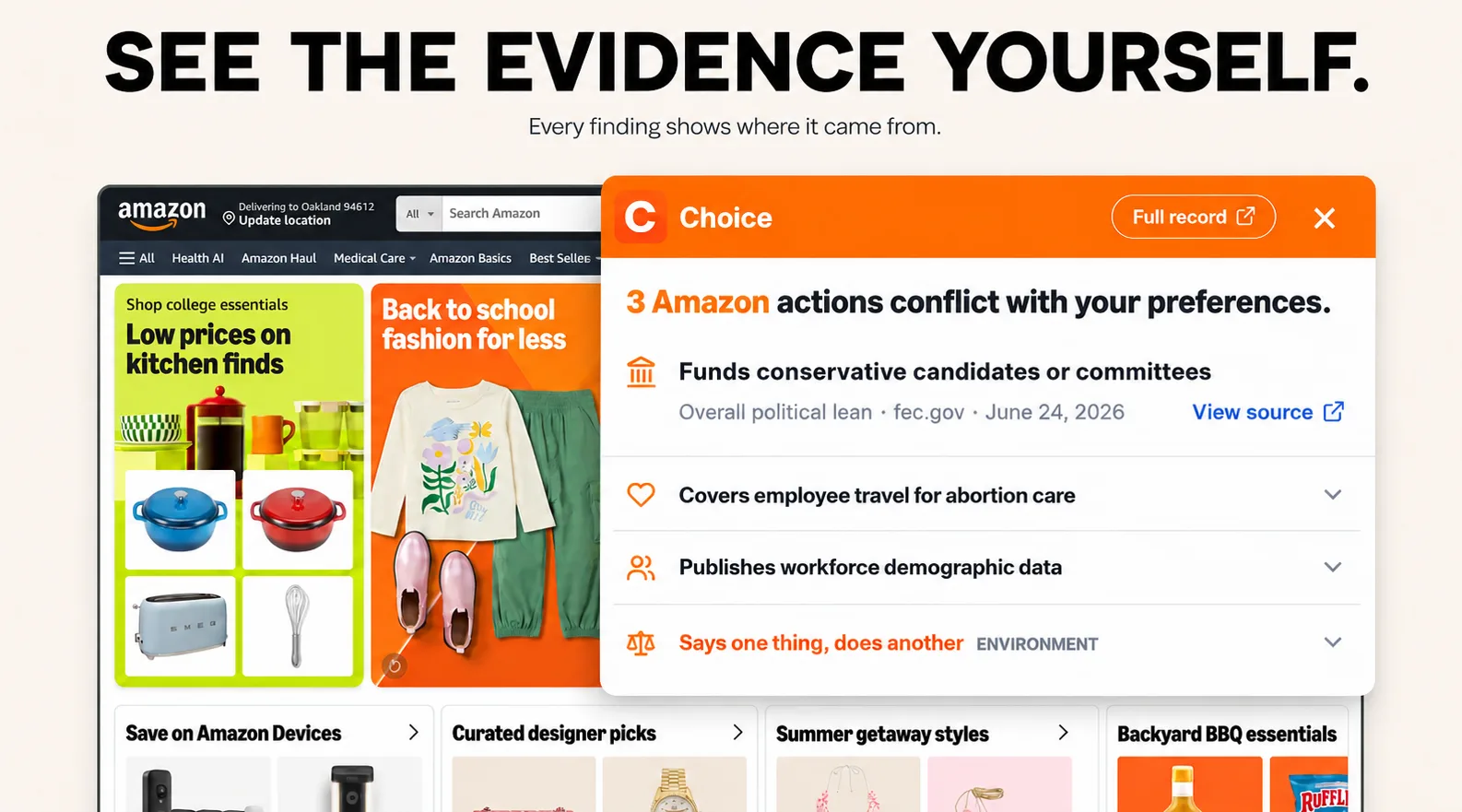
Choice shows what’s behind a product right on the page you’re on, and ranks companies by the issues you care about. No opinion baked in — just what companies do, and your priorities.
Sourced, not opinion. Every finding links to primary reporting.
Tuned to you. Pick the values that matter; Choice matches companies to them.